
服务热线
15852701687

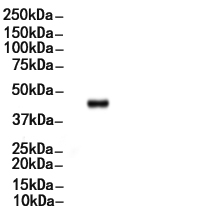
CD274 Antibody detects endogenous levels of total CD274.
Rabbit IgG in phosphate buffered saline , pH 7.4, 150mM NaCl, 0.02% sodium azide and 50% glycerol. Store at -20 °C. Stable for 12 months from date of receipt.
Programmed cell death ligand 1(CD274, or B7-H1, PD-L1), is the first member of B7 family to be discovered. B7 family molecules are type I transmembrane proteins belonging to the immunoglobulin superfamily. In concert with their CD28 family receptors, the B7s are key regulators of the adaptive immune response. CD274 is suggested a negative regulator of T and B cell, and play important role in mediating tolerance of lymphocytes to self-antigens. It also involved in the costimulatory signal, essential for T-cell proliferation and production of IL10 and IFNG, in an IL2-dependent and a PDCD1-independent manner.
CD274 Antibody detects endogenous levels of total CD274.
Rabbit IgG in phosphate buffered saline , pH 7.4, 150mM NaCl, 0.02% sodium azide and 50% glycerol. Store at -20 °C. Stable for 12 months from date of receipt.
Programmed cell death ligand 1(CD274, or B7-H1, PD-L1), is the first member of B7 family to be discovered. B7 family molecules are type I transmembrane proteins belonging to the immunoglobulin superfamily. In concert with their CD28 family receptors, the B7s are key regulators of the adaptive immune response. CD274 is suggested a negative regulator of T and B cell, and play important role in mediating tolerance of lymphocytes to self-antigens. It also involved in the costimulatory signal, essential for T-cell proliferation and production of IL10 and IFNG, in an IL2-dependent and a PDCD1-independent manner.
CD274 Antibody detects endogenous levels of total CD274.
Rabbit IgG in phosphate buffered saline , pH 7.4, 150mM NaCl, 0.02% sodium azide and 50% glycerol. Store at -20 °C. Stable for 12 months from date of receipt.
Programmed cell death ligand 1(CD274, or B7-H1, PD-L1), is the first member of B7 family to be discovered. B7 family molecules are type I transmembrane proteins belonging to the immunoglobulin superfamily. In concert with their CD28 family receptors, the B7s are key regulators of the adaptive immune response. CD274 is suggested a negative regulator of T and B cell, and play important role in mediating tolerance of lymphocytes to self-antigens. It also involved in the costimulatory signal, essential for T-cell proliferation and production of IL10 and IFNG, in an IL2-dependent and a PDCD1-independent manner.
CD274 Antibody detects endogenous levels of total CD274.
Rabbit IgG in phosphate buffered saline , pH 7.4, 150mM NaCl, 0.02% sodium azide and 50% glycerol. Store at -20 °C. Stable for 12 months from date of receipt.
Programmed cell death ligand 1(CD274, or B7-H1, PD-L1), is the first member of B7 family to be discovered. B7 family molecules are type I transmembrane proteins belonging to the immunoglobulin superfamily. In concert with their CD28 family receptors, the B7s are key regulators of the adaptive immune response. CD274 is suggested a negative regulator of T and B cell, and play important role in mediating tolerance of lymphocytes to self-antigens. It also involved in the costimulatory signal, essential for T-cell proliferation and production of IL10 and IFNG, in an IL2-dependent and a PDCD1-independent manner.
CD274 Antibody detects endogenous levels of total CD274.
Rabbit IgG in phosphate buffered saline , pH 7.4, 150mM NaCl, 0.02% sodium azide and 50% glycerol. Store at -20 °C. Stable for 12 months from date of receipt.
Programmed cell death ligand 1(CD274, or B7-H1, PD-L1), is the first member of B7 family to be discovered. B7 family molecules are type I transmembrane proteins belonging to the immunoglobulin superfamily. In concert with their CD28 family receptors, the B7s are key regulators of the adaptive immune response. CD274 is suggested a negative regulator of T and B cell, and play important role in mediating tolerance of lymphocytes to self-antigens. It also involved in the costimulatory signal, essential for T-cell proliferation and production of IL10 and IFNG, in an IL2-dependent and a PDCD1-independent manner.